
- All
- Product Name
- Product Keyword
- Product Model
- Product Summary
- Product Description
- Multi Field Search
Views: 0 Author: Site Editor Publish Time: 2026-06-16 Origin: Site


Every buyer faces a fundamental dilemma when choosing an Inflatable Boat. You must balance the initial purchase price against the long-term durability of the craft. You want reliable performance, yet picking the wrong fabric can severely reduce usable life. Material selection stands as the single largest predictor of longevity in this industry. However, actual lifespan relies on a complex formula. It combines base chemistry, factory seam construction methods, and your specific operational climate.
This article delivers an objective evaluation to help you shortlist the right material based on realistic durability expectations. We will explore the chemical realities of modern marine fabrics and expose hidden failure points. You will learn how to bypass best-case marketing claims. Read on to discover exactly which materials withstand harsh conditions and how to maximize your investment over the coming decades.
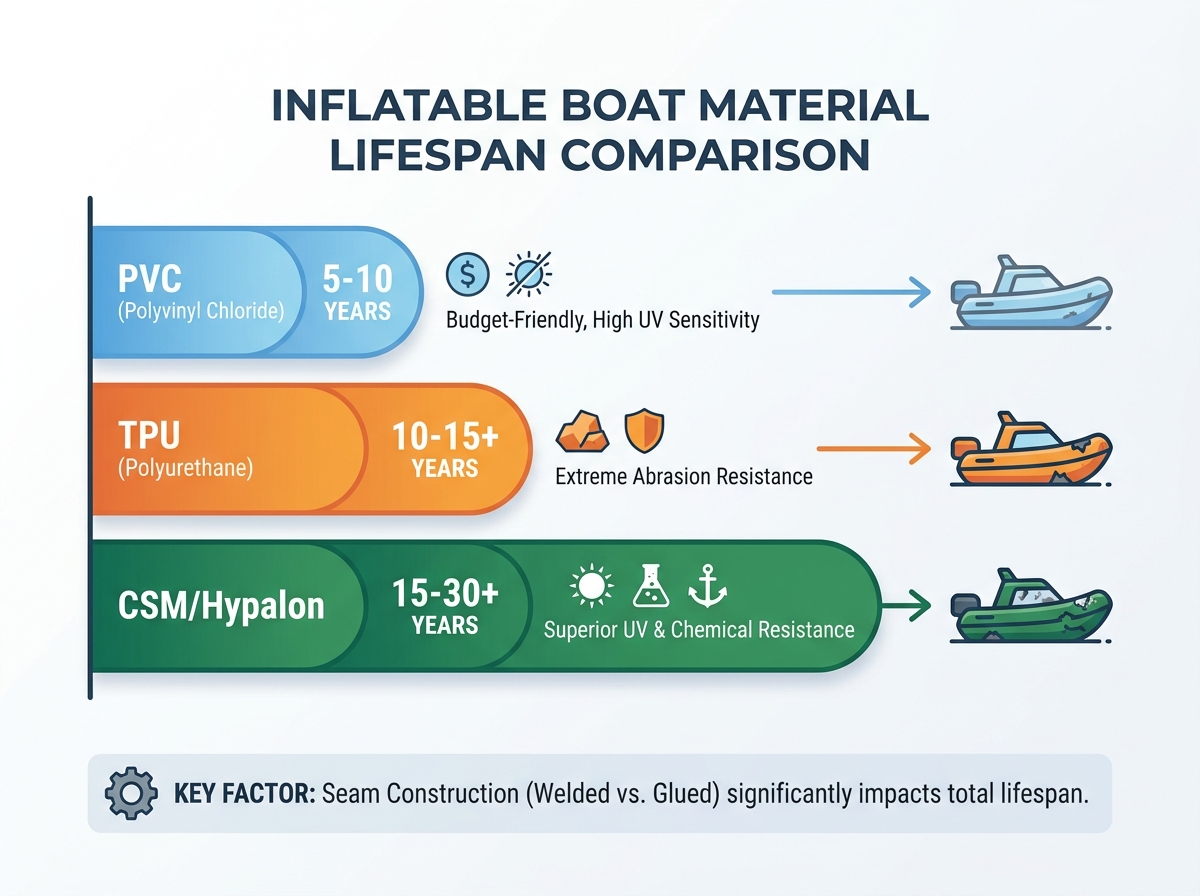
CSM/Hypalon is the longevity benchmark:Expected to last 15–30+ years, offering superior UV and chemical resistance, making it the standard for commercial and military applications.
Polyurethane (TPU) leads in abrasion resistance: Lasting 10–15+ years, it offers extreme puncture resistance but comes at a premium price point.
PVC is the budget-friendly baseline:Lasting 5–10 years, it provides excellent short-term ROI but is highly susceptible to UV degradation and heat-induced seam failure.
Construction matters as much as fabric: Welded seams (possible on PVC/TPU) often outlast the fabric, whereas glued seams (required for Hypalon) are subject to environmental degradation over decades.
Understanding marine fabrics requires looking past brand names. You must examine the base chemistry. The industry relies on three primary materials. Each possesses distinct chemical properties. These properties dictate how the fabric reacts to sun, salt, and physical trauma over time.
PVC serves as the most common and accessible marine fabric globally. However, its chemical structure requires specific additives for marine use.
Chemistry & Reality: PVC is naturally rigid. Manufacturers must add liquid plasticizers to make it flexible enough to roll and inflate. Over time, continuous UV exposure and ambient heat cause these plasticizers to migrate out of the material. The fabric eventually becomes brittle, prone to cracking, and distinctly sticky to the touch.
Common Mistakes: Leaving a PVC vessel uncovered on a dock all summer accelerates plasticizer migration exponentially.
Verdict: PVC remains highly cost-effective for recreational, temperate-climate use. It delivers excellent value if you store it indoors. However, it fails rapidly under permanent tropical UV exposure.
Hypalon represents the gold standard for heavy-duty marine applications. Originally trademarked by DuPont, this synthetic rubber dominates the professional sector.
Chemistry & Reality: Hypalon is a synthetic rubber elastomer. It is virtually immune to UV radiation, hydrocarbons like fuel or oil, and extreme temperature fluctuations. Unlike PVC, it does not rely on plasticizers for flexibility. It maintains its structural integrity organically over decades.
Best Practices: Choose Hypalon if you plan to leave the vessel moored outdoors year-round.
Verdict: This fabric commands the highest upfront cost. However, it yields the longest uninterrupted service life for vessels stored outdoors or deployed in harsh coastal environments.
Polyurethane bridges the gap between mechanical strength and environmental resistance. It has become increasingly popular in specialized expedition markets.
Chemistry & Reality: TPU is mechanically stronger than both PVC and Hypalon. It offers exceptional abrasion and puncture resistance. A sharp rock might slice PVC, but it will often bounce right off a TPU tube. It boasts strong UV resistance, though it falls slightly short of Hypalon in permanent sun exposure.
Verdict: TPU stands out as the ideal choice for rocky river environments or heavy-duty operational deployments. It excels where physical trauma presents a higher daily risk than sun damage.
The table below summarizes how these materials compare across key performance metrics.
| Material | Expected Lifespan | UV Resistance | Abrasion Resistance | Compatible Seam Construction |
|---|---|---|---|---|
| PVC | 5–10 Years | Low to Moderate | Moderate | Welded or Glued |
| TPU | 10–15+ Years | High | Exceptional | Welded or Glued |
| Hypalon | 15–30+ Years | Exceptional | High | Glued Only |
Choosing the right fabric requires looking at replacement cycles rather than just the initial price tag. You must evaluate how often you will need to replace the vessel based on your specific usage profile.
Consider the replacement cycle of a standard vessel. A budget PVC model might cost much less upfront. However, you may need to replace it twice over a 15-year period due to fabric degradation or seam failure. Conversely, investing in a premium Hypalon model eliminates those replacement cycles. The Hypalon vessel can easily serve you continuously for 20 years. When evaluating longevity, focus on the number of uninterrupted seasons the fabric provides.
Your geographic location dictates material survival more than any other factor.
High UV and Tropical Climates: In regions near the equator, PVC degrades exponentially faster. Hypalon becomes strictly required for long-term viability in these sun-drenched environments.
Temperate Climates and Indoor Storage: If you boat in northern latitudes or store your vessel in a climate-controlled garage, PVC lifespans can stretch to 10 or even 12 years. This specific scenario narrows the durability gap between budget and premium materials.
Fabric alone does not keep water out. The seams hold the entire structure together. You must evaluate glued versus thermo-welded seams.
PVC and TPU allow for machine welding. High-frequency welding fuses the two overlapping fabric layers into a single continuous piece of material. This creates a mechanical bond stronger than the surrounding fabric itself. Welded seams simply do not melt in the sun.
Hypalon, however, cannot be thermo-welded. It must be hand-glued. This process requires meticulous quality control at the factory level. Glued seams rely entirely on the chemical strength of the adhesive. While the Hypalon fabric may last 30 years, poorly executed glue lines can fail much sooner under extreme heat.
Many buyers focus entirely on the tube fabric. They overlook how structural design influences material stress. The foundation of the vessel dictates how much mechanical abuse the fabric must endure.
Fully inflatable soft-bottom boats lack structural rigidity. As they move through choppy water, the entire vessel flexes. This continuous structural flex creates stress on the tube fabric and the seams. Over time, this movement causes flex fatigue. Furthermore, beaching a soft-bottom boat exposes the vital air-holding fabric directly to sand, rocks, and abrasive concrete boat ramps.
A rigid inflatable boat fundamentally changes this dynamic. It limits the structural load placed directly on the inflatable tubes. A solid V-hull—typically constructed from fiberglass or marine-grade aluminum—cuts through the water. It absorbs the primary wave impact. The fabric collar simply provides buoyancy and stability. Because the hull handles the friction and collision forces, the fabric experiences far less mechanical stress. This physical separation dramatically extends the tube's functional life.
Professional applications highlight this necessity perfectly. Consider why a compact coastal patrol rigid inflatable boat relies almost exclusively on Hypalon or heavy-grade TPU. The rigid aluminum or fiberglass hull provides impact dominance against docks and other vessels. Meanwhile, the premium tube material withstands constant UV exposure and chemical spills, like salt spray and fuel overflow. The combination of a solid hull and top-tier fabric creates an virtually indestructible platform for extreme conditions.
Vessels rarely fail because a single wave tears them apart. They usually die slow deaths from environmental neglect and chemical breakdown. Understanding these silent killers helps you intervene before damage becomes irreversible.
As mentioned earlier, PVC degrades through a specific chemical process. You will notice a sticky, tacky residue forming on aging PVC tubes. This is not dirt. It represents plasticizer off-gassing. The chemical plasticizers migrate to the surface and react with UV light. Once this sticky residue appears, the chemical breakdown becomes irreversible. The fabric will quickly lose its flexibility and fail.
Extreme heat serves as the primary enemy of glued seams. When you leave a boat fully inflated on a 100-degree summer day, the internal air pressure skyrockets. Simultaneously, the sun bakes the glued seams. Extreme heat softens the glue on poorly manufactured vessels. The rising pressure pushes against the softened glue, leading to sudden and catastrophic air loss. This delamination happens entirely independently of the fabric's actual condition.
Vessels face severe off-water hazards. Several threats routinely destroy fabrics during storage:
Rodents: Mice and rats frequently nest inside rolled-up boats during winter storage, chewing rapidly through both PVC and Hypalon.
Mold and Mildew: Storing a damp boat allows mold spores to penetrate the fabric scrim. This rots the structural core of the material from the inside.
Harsh Cleaners: Using petroleum-based cleaners, bleach, or acetone strips away factory-applied UV protective coatings.
Running your vessel below its recommended PSI damages it faster than sun exposure. Here is exactly how under-inflation destroys the material from the inside out:
The tubes lose their rigid cylindrical shape under low pressure.
The fabric begins to sag and fold upon itself when hitting waves.
These loose folds constantly chafe against the hard transom and fiberglass hull.
The relentless friction grinds away the internal airtight coating, causing slow, unpatchable leaks.
You can actively extend the lifespan of any marine fabric. Implementing a few fundamental maintenance routines yields decades of reliable use.
You must defend the chemical structure of your fabric against the sun. We highly recommend specialized UV-blocking sprays, such as 303 Aerospace Protectant, for PVC and TPU fabrics. These sprays act like sunscreen for your vessel. Applying them every few months significantly slows plasticizer migration and prevents the fabric from drying out.
Temperature dictates pressure. A tube inflated perfectly in the cool morning will over-expand under the afternoon sun. Using pressure relief valves (PRVs) represents a critical safety measure. These valves automatically release excess air when internal pressure spikes. PRVs prevent heat-induced seam blowouts on high-temperature days.
The operational reality is simple: you must cover your boat. A high-quality, breathable, UV-resistant boat cover transforms longevity expectations. Keeping the sun off the fabric when not in use can extend a standard PVC boat's life by 30% to 50%. Ensure the cover remains breathable to prevent trapped moisture and mold growth.
Avoid harsh household chemicals at all costs. Never use bleach, acetone, or heavy industrial detergents. Instead, recommend mild marine-specific soaps. Gently wash the tubes with a soft brush and fresh water. This preserves the factory finish, protects the seam integrity, and washes away corrosive salt crystals.
Selecting the right material dictates the ultimate success of your marine investment. You must align your fabric choice with your budget, storage realities, and operational climate.
Choose PVC for strict budgets and guaranteed indoor storage in temperate zones. Opt for TPU if you navigate shallow, rocky, high-abrasion river environments. Finally, select Hypalon for maximum long-term lifespan and permanent outdoor marine deployment.
Before making your final decision, take two immediate steps. First, verify the exact seam construction method (welded versus glued) used on your shortlisted models. Second, scrutinize the manufacturer warranty terms, paying special attention to coverage limits on fabric versus seam failure.
A: It is highly unlikely under normal conditions. A PVC boat can only reach 20 years under extreme, meticulous care. You would need to store it fully inflated in a climate-controlled, strictly UV-free environment. This is not the standard reality for regular marine use, where 5 to 10 years is the expected norm.
A: You can perform the sandpaper and acetone test. Lightly sand a hidden patch; Hypalon creates a dull dust, whereas PVC simply scratches. Next, wipe it with acetone. Hypalon resists the chemical completely. PVC becomes distinctly sticky and dissolves slightly under the acetone.
A: Yes, if the core structure remains sound. If your fiberglass or aluminum hull is pristine, re-tubing with fresh Hypalon proves highly cost-effective. It costs significantly less than buying an entirely new vessel while delivering a factory-fresh lifespan.
A: Yes. Darker colors, like dark grey or black, absorb significantly more solar heat. This rapid heat absorption increases internal PSI and severely stresses the seams. Pressure relief valves become absolutely critical if you purchase dark-colored tubes.


