
- All
- Product Name
- Product Keyword
- Product Model
- Product Summary
- Product Description
- Multi Field Search
Views: 0 Author: Site Editor Publish Time: 2026-06-30 Origin: Site


Many buyers hesitate when facing the premium price tag of a hybrid vessel. They often wonder how it justifies the extra expense compared to traditional fiberglass hulls or standard soft-collar options. This initial hesitation is entirely normal. A rigid inflatable boat utilizes a unique dual-architecture approach. It combines a solid deep-V lower hull with a shock-absorbing pneumatic collar. Understanding this sophisticated design helps you see why these vessels dominate demanding marine environments.
We will explore the exact technical mechanics driving these engineering choices. You will learn how the synergy between solid hulls and pressurized tubes dictates on-water performance. By breaking down specific materials and design principles, this guide shows you exactly what you get for your investment. We will examine how these vessels maximize safety and extend operational longevity across severe conditions.
Hybrid Engineering: A RIB operates by utilizing a rigid lower hull to cut through waves, while pressurized outer tubes provide dynamic stability and redundant buoyancy.
Material Selection Drives Lifespan: The choice between Hypalon and PVC tubes, or aluminum and fiberglass hulls, directly impacts UV resistance, weight, and operational longevity.
Risk Mitigation: Multi-chambered tube designs ensure that a single puncture does not result in catastrophic vessel failure.
Scalable Applications: From high-speed recreational use to deploying a customizable coastal patrol RIB boat, the underlying mechanics can be tailored to specific payload and endurance requirements.
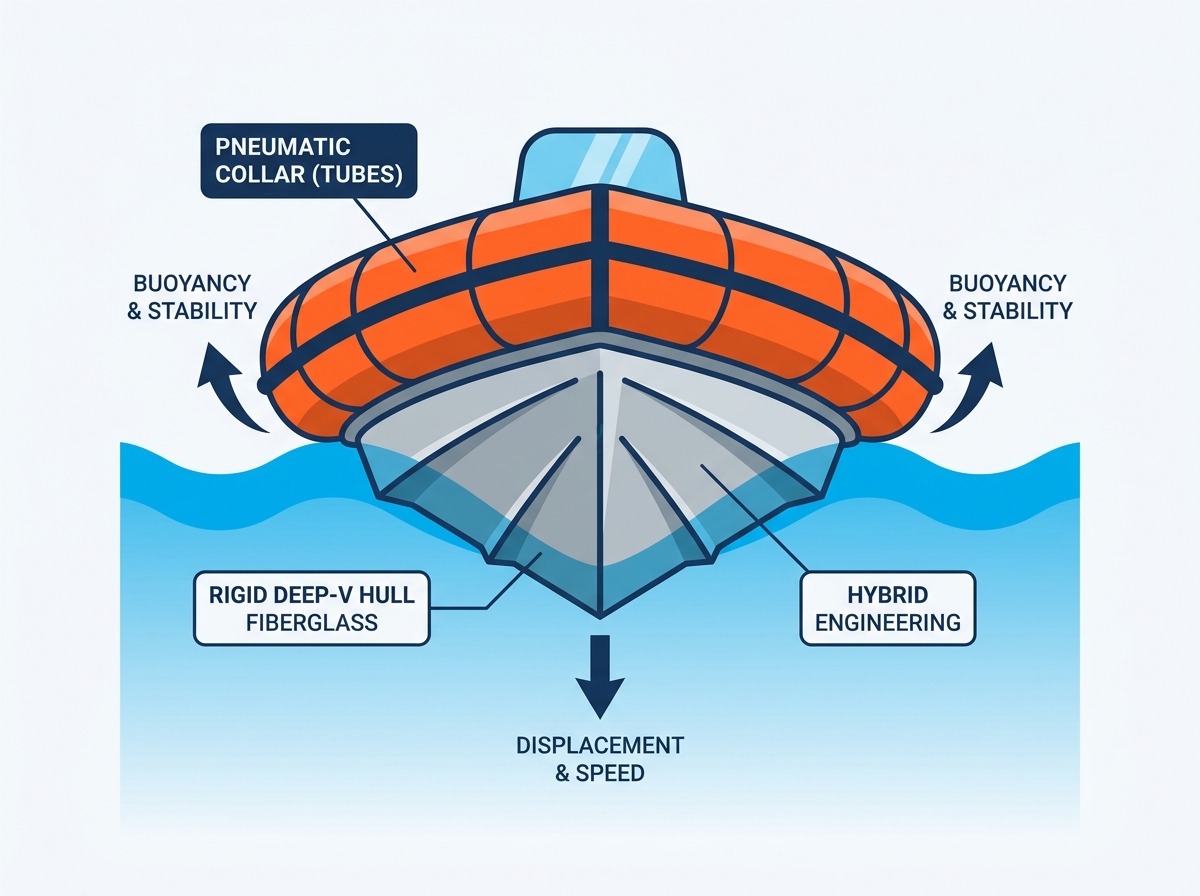
To grasp vessel performance, we must first look at the underlying physics. The hybrid design merges two distinct maritime philosophies. It integrates displacement mechanics with pneumatic buoyancy.
Every true rigid inflatable boat features a solid lower section. Builders typically mold this section into a deep-V shape. This rigid framework displaces water efficiently. It dictates the absolute top speed of the vessel. The sharp deadrise angle cuts through heavy chop rather than slamming into it. This action ensures strict directional stability. You avoid the dangerous sliding feeling common in flat-bottom boats. The rigid hull essentially anchors the vessel in the water column.
The inflatable outer ring serves as a massive, adaptive shock absorber. When you encounter heavy chop, the boat naturally begins to roll. As the hull dips, the buoyant tubes hit the water surface. This contact drastically increases the effective beam of the boat. It provides immediate righting moments. The pneumatic collar pushes back against the water. This rapid displacement stabilizes the deck instantly. It prevents extreme heel angles during aggressive maneuvers.
Weight distribution plays a critical role in maritime safety. Traditional hard-sided vessels carry heavy fiberglass or metal high above the waterline. Hybrid designs place lightweight outer tubes around the perimeter. This configuration keeps the vessel's center of gravity remarkably low.
Consider the benefits of a low center of gravity:
You can execute tighter, high-speed turns.
You drastically reduce the risk of rolling over in following seas.
You experience less pendulum motion when stationary.
You give passengers a much more comfortable ride.
Your operational environment must dictate your material choices. Selecting the wrong fabric or hull material severely degrades performance. It also accelerates component wear.
Builders primarily use two distinct synthetic fabrics for the pneumatic collars. Understanding their chemical properties helps you make an informed decision.
Hypalon (CSM): Chlorosulfonated Polyethylene carries a higher upfront cost. However, it delivers exceptional UV and chemical resistance. Hypalon resists fuel spills, extreme heat, and mechanical abrasion. Commercial operators rely on this fabric. A well-maintained Hypalon collar often boasts a lifespan exceeding 15 to 20 years. You will find it necessary for vessels facing constant sun exposure.
PVC: Polyvinyl Chloride provides a lighter, more affordable alternative. It handles moderate use perfectly well. However, PVC remains highly susceptible to UV degradation over time. The sun causes the plasticizers to leach out. The fabric eventually becomes brittle and prone to cracking. PVC fits budget-conscious operators. It works best for applications where operators store the vessel indoors or under heavy covers.
The solid lower section also requires careful material evaluation. Each option presents unique handling characteristics.
Aluminum: Marine-grade aluminum offers a superior strength-to-weight ratio. It boasts incredibly high impact resistance. If you strike a submerged log, aluminum typically dents rather than shatters. Choose aluminum for rocky shorelines or heavy-duty commercial use.
Fiberglass (GRP): Glass-reinforced plastic weighs significantly more than aluminum. This extra mass provides a smoother ride in heavy seas. The weight helps the hull punch through waves. Fiberglass allows builders to create complex molded deck layouts. It easily accommodates integrated seating and storage. Furthermore, fiberglass generally requires less specialized repair skills than welding aluminum.
| Material Category | Primary Option | Key Advantage | Best Use Case |
|---|---|---|---|
| Tube Fabric | Hypalon (CSM) | Extreme UV/Chemical resistance | Tropical climates, commercial duty |
| Tube Fabric | PVC | Lightweight, cost-effective | Temperate climates, covered storage |
| Hull Structure | Aluminum | High impact resistance, light weight | Rocky environments, beaching |
| Hull Structure | Fiberglass (GRP) | Heavy mass for smooth ride, moldability | Offshore cruising, complex layouts |
Technical specifications mean little without real-world benefits. The hybrid design translates directly into measurable operational outcomes. These vessels solve complex maritime challenges efficiently.
Standard boats rely entirely on hull volume for displacement. The high buoyancy of the inflatable collar completely changes this dynamic. RIB Boats carry significantly heavier payloads than traditional vessels of the same length. The tubes displace massive amounts of water when compressed. You can load these boats with heavy dive gear or numerous passengers. Consequently, you require less horsepower to get the vessel on a plane. This efficiency improves your effective range.
Military and rescue organizations adopt these vessels for a specific reason. They survive conditions where other boats fail. The pressurized tubes actively dampen kinetic energy from wave impacts. When the hull drops into a trough, the collar cushions the landing. This shock absorption drastically reduces crew fatigue. Operators can maintain higher speeds safely in deteriorating sea states.
Hybrid architecture maximizes usable deck space. Builders push the collar outward, leaving the internal footprint open. You can configure this space for highly specialized missions. For example, specifying a customizable coastal patrol RIB boat requires evaluating specific operational needs. You must plan console placement carefully. You need to integrate shock-mitigating seating. You must route wiring for heavy electronics seamlessly. The open deck allows endless modular configurations.
Best Practice: Always conduct a weight study before customizing the deck. Ensure heavy consoles stay centered over the keel.
Common Mistake: Overloading the bow with heavy storage lockers, which compromises the deep-V entry angle.
Every vessel requires upkeep. Transparent analysis of ownership demands helps you plan effectively. You must separate maritime myths from engineering realities.
Many novice buyers fear catastrophic punctures. They imagine a single hook or submerged branch sinking the vessel. This represents a fundamental misunderstanding. Every commercial-grade Inflatable Boat utilizes a multi-chamber valving system. Internal baffles divide the collar into independent air zones. If one section loses pressure, the remaining chambers stay fully inflated. The rigid hull itself also provides substantial inherent buoyancy. You maintain sufficient flotation to return safely to port.
Pneumatic collars demand specific, predictable routines. You cannot neglect them. You must apply dedicated UV protectants monthly. You need to wash saltwater off the fabric to prevent crystal abrasion. You must inspect the inflation valves for sand or debris. Pressure monitoring proves vital. Air expands in the afternoon heat and contracts in the evening. You must adjust tube pressure manually to prevent seam stress.
The rigid hull will inevitably outlast the pneumatic collar. You must acknowledge this reality upfront. Even premium Hypalon fabrics eventually wear out. You will likely face a collar replacement at the 10-to-15-year mark. Do not view this as a failure. Factor the cost and downtime of "retubing" into your long-term planning. Treat it as a completely predictable operational expense.
Navigating the market requires a structured approach. You must filter options based on rigorous mechanical criteria. Follow these steps to assess specific models accurately.
Never buy a vessel without analyzing your primary operational environment. Match the vessel length and deadrise angle to your local sea state. Offshore operations demand a deep-V hull. This aggressive angle slices through massive ocean swells. Conversely, inland lakes and rivers require a shallow draft. A flatter hull allows you to navigate shallow estuaries safely. Do not compromise on hull shape.
Examine the manufacturing details closely. Look at the seams first. Welded seams generally provide stronger bonds for PVC fabrics. Glued seams remain the industry standard for Hypalon. Next, inspect the hull-to-tube attachment methods. Some builders use slide-on mechanical tracks. This method makes future retubing much easier. Other builders glue the collars directly to the fiberglass flange. Glued collars often provide a tighter seal but complicate future maintenance.
A reputable builder stands behind their product. Check for stringent CE or NMMA certifications. These badges prove the vessel meets global safety standards. Read the warranty terms meticulously. You must specifically distinguish the tube warranty from the hull warranty. They often carry vastly different durations. Confirm local parts availability. If you are actively comparing rigid inflatable boats for sale, verifying the manufacturer’s aftermarket support remains your most crucial task.
The fundamental mechanics of hybrid vessels rely on brilliant synergy. By merging rigid displacement with pneumatic buoyancy, engineers created an inherently safer platform. The solid hull handles directional tracking and speed. The pressurized collar provides dynamic stability and massive shock absorption. Together, they form an incredibly versatile maritime tool.
The immense value of this architecture justifies the premium price tag. If you require rough-water capability, you need this design. If your mission demands high payload capacity, few alternatives compare. Commercial-grade reliability comes from thoughtful material selection and rigorous upkeep routines.
Your next step requires strict definition. Document your exact operational environment. Outline your specific payload needs. Establish a firm budget. Once you map these parameters, request formal sea trials. Engage directly with certified builders to explore custom configurations tailored to your waters.
A: Yes. Their low center of gravity, deep-V hulls, and buoyant shock-absorbing collars make them the industry standard for search and rescue operations in severe conditions.
A: Hypalon tubes typically last 15-20 years with proper care, while PVC tubes average 5-10 years depending on UV exposure and maintenance.
A: The tubes are divided into multiple independent air chambers. A single puncture only deflates one section, allowing the boat to safely remain afloat and operable.
A: The dual-manufacturing process—requiring both rigid fiberglass/aluminum fabrication and complex textile engineering for the pneumatic collars—drives up upfront production costs.


