
- All
- Product Name
- Product Keyword
- Product Model
- Product Summary
- Product Description
- Multi Field Search
Views: 0 Author: Site Editor Publish Time: 2026-07-21 Origin: Site


The defining characteristic of a panga boat—its narrow beam, high bow, and shallow draft—creates a highly specific weight-to-length ratio that fundamentally differs from traditional deep-V center consoles. Buyers evaluating a panga must accurately calculate both dry hull weight and fully loaded displacement (wet weight) to ensure safe towing, select the correct outboard horsepower, and verify shallow-water draft capabilities. Failing to account for wet weight often leads to under-rigged vessels or overloaded trailers.
This guide breaks down the average weights of panga boats by length, analyzes the variables that contribute to fully loaded displacement, and provides an evaluation framework for matching hull weight to performance requirements. You will learn how to transition from manufacturer dry specifications to real-world operational weight.
Size-to-Weight Ratio: Panga boats are exceptionally light for their length; a 22-foot panga typically features a dry hull weight of roughly 1,150 lbs, significantly less than standard fiberglass boats of the same length.
Displacement Realities: Fully loaded weight (including outboard, fuel, gear, and passengers) often doubles the dry hull weight, requiring precise calculations for trailer and tow-vehicle matching.
Performance Outcomes: The low overall weight directly translates to operational cost savings, frequently yielding 5+ MPG at cruising speeds and allowing for smaller, less expensive outboards.
Towing Advantages: Due to their lightweight construction, most sub-26-foot pangas can be safely towed by mid-size SUVs or half-ton pickups, lowering the barrier to entry for prospective buyers.
Establishing accurate baseline weights is critical for initial shortlisting and logistical planning. Knowing the dry weight helps you determine trailer requirements and engine sizing before committing to a specific hull. We break these down into three primary categories based on length and intended application.
Small utility models represent the most basic and lightweight configurations available. The average dry hull weight ranges from 350 lbs to 900 lbs. For example, a standard W-16 utility model features a dry hull weight of just 374 lbs. This specific hull utilizes an ultra-narrow beam of 4.59 feet, yet maintains a payload capacity of 992 lbs.
These vessels are primarily used as tiller-steered skiffs. They feature minimal rigging and excel in ultra-shallow draft applications. Because of their minimal mass, they only require modest outboards ranging from 9.9 HP to 25 HP, typically mounted on a 22-inch transom. You will often see these used in backwater estuaries where launching from unimproved ramps is necessary.
Stepping up to mid-size coastal models introduces more fiberglass material and wider beams. The average dry hull weight for this category ranges from 1,000 lbs to 2,000 lbs. A standard 22-foot coastal panga with a 6-foot 6-inch beam averages 1,150 lbs dry. Meanwhile, a 26-foot model featuring a 7-foot beam averages around 1,700 lbs dry.
These boats serve versatile nearshore fishing applications. The increased weight and length provide better stability in coastal chop while still allowing operators to use moderate outboards, usually between 90 HP and 150 HP. The center console configurations in this size range add about 150 to 200 lbs of fiberglass and rigging weight compared to tiller models.
Offshore variants demand heavier lamination schedules to withstand punishing sea conditions. The average dry hull weight here spans from 2,200 lbs to over 3,500 lbs. A fully integrated 32FT Fiberglass Panga Boat requires substantial structural reinforcement to support high payload capacities and twin outboard configurations.
These heavy-duty hulls are built for offshore runs and commercial fishing operations. The added weight lowers the center of gravity and improves the ride in heavy seas, though it significantly alters towing requirements. You must account for heavy-duty stringer grids and thicker transom cores in these models.
| Length Category | Average Dry Hull Weight | Typical Beam Width | Primary Application |
|---|---|---|---|
| 15ft - 20ft | 350 lbs - 900 lbs | 4.5ft - 5.5ft | Shallow water, utility skiffs |
| 21ft - 26ft | 1,000 lbs - 2,000 lbs | 6.0ft - 7.0ft | Coastal fishing, nearshore |
| 28ft - 32ft | 2,200 lbs - 3,500+ lbs | 7.5ft - 8.5ft | Offshore, commercial use |
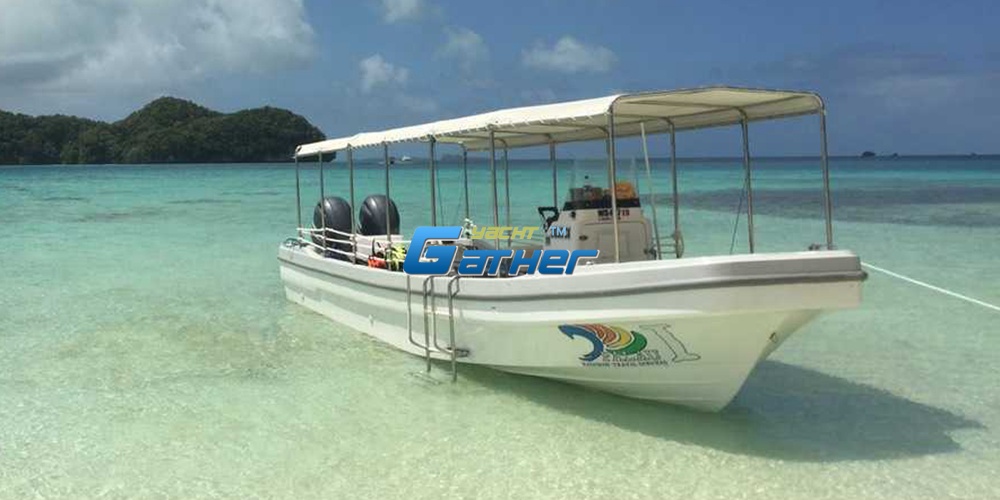
Moving from manufacturer specifications to real-world operating weight prevents under-rigging and unsafe towing. Dry weight only accounts for the bare fiberglass hull. Wet weight dictates how the boat actually performs on the water and behaves on the highway.
To determine the actual towing weight, you must calculate the sum of all components. The formula is: Dry Hull Weight + Outboard Motor(s) + Fuel Weight (6 lbs per gallon) + Batteries and Rigging + Trailer Weight + Gear and Payload.
Consider a 22-foot panga with a 1,150 lb dry weight. Once you add a 359 lb motor (like a 90 HP 4-stroke), 20 gallons of fuel (120 lbs), batteries, fishing gear, and a standard single-axle trailer, the total towing weight easily reaches 2,300 lbs. This effectively doubles the advertised dry weight. You must run these numbers before purchasing a tow vehicle.
Identify the manufacturer's stated dry hull weight.
Add the exact weight of your chosen outboard motor, including rigging and fluids.
Multiply your maximum fuel capacity by 6 pounds to find total fuel weight.
Add 150 lbs for batteries, anchors, and safety gear.
Add the weight of the trailer itself (typically 600 to 1,200 lbs depending on axles).
Fuel is one of the heaviest variable loads on any vessel. Standard mid-size pangas carry between 39 and 49 gallons of fuel. At 6 pounds per gallon, a full 49-gallon tank adds nearly 300 lbs to the stern.
Larger offshore models scale up significantly, holding up to 160 gallons. This fuel capacity adds nearly 1,000 lbs of wet weight. Conversely, 16-foot utility models may only carry 10 to 20 gallons in portable tanks, keeping the overall displacement extremely low. Managing your fuel load is a practical way to control your draft on the flats.
Modern 4-stroke outboards add substantial weight to the transom. A standard 90 HP motor weighs approximately 359 lbs with a 1496 CC displacement. You must factor this into the static draft and center of gravity.
The compounding effect of twin-engine setups on 28-foot and larger models requires careful planning regarding transom weight limits. Hanging two heavy outboards off the back of a narrow hull shifts the center of gravity aft, which can affect the resting draft and time-to-plane. Always check the maximum transom weight rating plate.
Analyzing the architectural differences reveals why these vessels maintain such low mass. The design choices prioritize efficiency and utility over massive interior volume.
The primary reason for the low weight is the length-to-beam ratio. A W-16 model features a 4.59-foot beam, while a 26-foot model might only measure 7 feet at its widest point. This narrow footprint drastically reduces the total surface area of the hull.
Less surface area and reduced internal volume directly equate to less raw material required during manufacturing. Fewer square feet of fiberglass and resin naturally result in a lighter finished product compared to wide-body center consoles. This narrow entry also allows the hull to slice through chop efficiently.
Modern layup techniques optimize the strength-to-weight ratio. A well-built fiberglass boat places structural reinforcement only where necessary, such as the keel, chines, and transom, while keeping the upper topsides relatively thin.
Many builders now use composite transoms and advanced stringer grids. These materials eliminate wood rot and reduce unnecessary mass, ensuring the hull remains rigid without adding dead weight. Vacuum infusion processes further control the resin-to-glass ratio, stripping out excess weight.
A lighter hull presents specific operational realities. While highly efficient, a lighter boat with a narrow beam can be more susceptible to rolling at rest. It lacks the massive displacement that dampens lateral movement.
Furthermore, a light hull may ride harsher in steep, short-period chop compared to a heavy deep-V hull. The heavy deep-V crushes through waves, whereas the lighter panga relies on its sharp entry to slice the water, sometimes resulting in a more active ride in rough conditions. You must actively trim the bow down to utilize the sharp entry.
Translating weight metrics into tangible operational benefits helps buyers understand the true value of the design. Low mass affects every aspect of vessel operation.
The lack of weight translates directly into exceptional fuel economy. A lightweight fiberglass panga can achieve 5.2 MPG at a 25 MPH cruising speed, burning only 4.7 gallons per hour.
In contrast, a heavier traditional fiberglass boat of similar length may only achieve 3 MPG at 28 MPH, burning 9.4 gallons per hour. The panga effectively cuts fuel consumption in half for the same distance traveled. This extends your range significantly on a smaller fuel tank.
Because of the low displacement, pangas sit much higher in the water. The hull does not need to displace as much water to stay afloat.
A standard panga often draws 2.5 inches less water than competing deep-V fiberglass hulls. This shallow draft allows operators to access skinny water flats, navigate tidal creeks, and beach the vessel easily. You can push-pole a 22-foot panga in water that would ground a traditional bay boat.
The financial benefit of low weight becomes obvious during the rigging phase. You can achieve speeds of 35+ knots with a modest, single outboard. A 90 HP to 115 HP motor is often more than enough for a 22-foot hull.
Traditional boats of the same length often require a 200 HP or larger motor to achieve similar performance. Using a smaller engine drastically reduces the initial purchase price, lowers maintenance costs, and minimizes the weight hanging on the transom.
Preventing logistical failures post-purchase requires matching your support equipment to the true wet weight of the vessel.
The most common risk is buying a trailer rated only for the dry hull weight. If you purchase a trailer with a 1,500 lb capacity for a 1,150 lb dry hull, you will overload the axles as soon as you add the engine, fuel, and gear.
Always size the trailer based on the fully loaded displacement calculation. Ensure the tow vehicle's hitch and braking system are rated for the combined weight of the loaded boat and the trailer itself. For those looking at panga boats for sale, factoring in the cost of a properly rated trailer is a mandatory step in the budgeting process.
Calculate your total wet weight by adding the dry hull weight, outboard, full fuel tank, and gear before selecting a trailer.
Match your outboard horsepower to the hull's weight-to-length ratio rather than defaulting to the maximum rated horsepower.
Verify your tow vehicle's capacity against the combined weight of the fully loaded boat and trailer to ensure highway safety.
Evaluate your typical sea conditions to determine if the lighter weight and narrow beam align with your comfort requirements in rough water.
A: A standard 22-foot coastal panga typically has a dry hull weight of approximately 1,150 lbs. This weight only accounts for the bare fiberglass hull and does not include the motor, fuel, rigging, or accessories.
A: A fully loaded 22-foot panga, including the hull, a 90 HP outboard, fuel, gear, and a single-axle trailer, generally weighs around 2,300 lbs. Larger 26-foot models can exceed 3,500 lbs on the trailer.
A: Panga boats feature a narrow beam and exceptionally light fiberglass construction. Because they have less mass and drag to push through the water, they achieve high speeds and quick planing with significantly less horsepower than traditional deep-V boats.
A: Yes, most mid-size SUVs can easily tow panga boats under 26 feet. Since the fully loaded towing weight of a 22-foot model is roughly 2,300 lbs, it falls well within the 3,500 to 5,000 lb towing capacity of standard SUVs.
A: The low overall weight means the hull displaces less water, allowing the boat to sit higher on the surface. This results in a very shallow draft, often drawing several inches less than heavier traditional fiberglass boats of the same length.


