
- All
- Product Name
- Product Keyword
- Product Model
- Product Summary
- Product Description
- Multi Field Search
Views: 0 Author: Site Editor Publish Time: 2026-06-09 Origin: Site


Summer approaches rapidly, bringing a sudden seasonal urgency to acquire watercraft. This rush often saturates the market quickly. Vendors heavily promote low-quality PVC vessels to eager, inexperienced buyers. You must look past the flashy marketing hype to find a reliable vessel. The baseline for any sound decision lies in matching the hull design, material, and capacity to your exact operational environment. A mismatch here leads to poor performance. You will struggle whether you plan casual lake recreation or rigorous open-ocean transit. Aligning these technical factors correctly ensures both safety and long-term satisfaction on the water. This article provides a hype-free, criteria-based evaluation of this summer's top-rated categories. We explore the distinct differences between soft-bottom designs and rigid hulls. You will also learn how to evaluate material longevity and professional-grade specifications. By the end, you can navigate the busy market and make a high-confidence purchase.
Hull type dictates performance: Soft-bottom/roll-up boats maximize storage and portability, while Rigid Inflatable Boats (RIBs) offer superior handling and structural integrity for rougher waters.
Material lifespan: The choice between PVC and Hypalon (CSM) should be dictated by UV exposure hours and budget rather than marketing claims.
Professional scalability: High-intensity use cases require specific configurations, such as a professional grade rigid inflatable boat, which fundamentally alters towing and engine requirements.
Most buyers misunderstand their logistical reality initially. They visualize pristine lake days. They ignore the physical reality of hauling heavy equipment. You must define your storage footprint immediately. A mismatch here guarantees frustration. You will simply stop using the vessel. We see this mismatch constantly in the marine industry. You must align your storage capability with your performance expectation.
These vessels prioritize pure portability above all else. You deflate them completely after use. They fold down into heavy-duty storage bags. You can easily fit them inside RV compartments. They slide into SUV trunks without issue. They serve as the ultimate yacht tender for smaller motherships. Families utilize them extensively for calm-water summer recreation.
Floor evaluation dictates your daily experience on the water. High-pressure air floors utilize advanced drop-stitch technology. Thousands of internal threads connect the top and bottom layers. You inflate them to high pressures. They become remarkably rigid. They offer quick setup times. They significantly reduce overall hull weight. Conversely, aluminum or wood floorboards provide superior deck stability. You can stand on them firmly. However, they demand a heavier assembly process. You must slide side stringers into place manually. This requires practice and physical effort.
Implementation reality brings certain hydrodynamic limits. Soft-bottom designs face slower planing speeds. They exhibit higher vulnerability to chop. The flat fabric bottom bounces over surface waves. You experience a wetter, rougher ride in poor conditions.
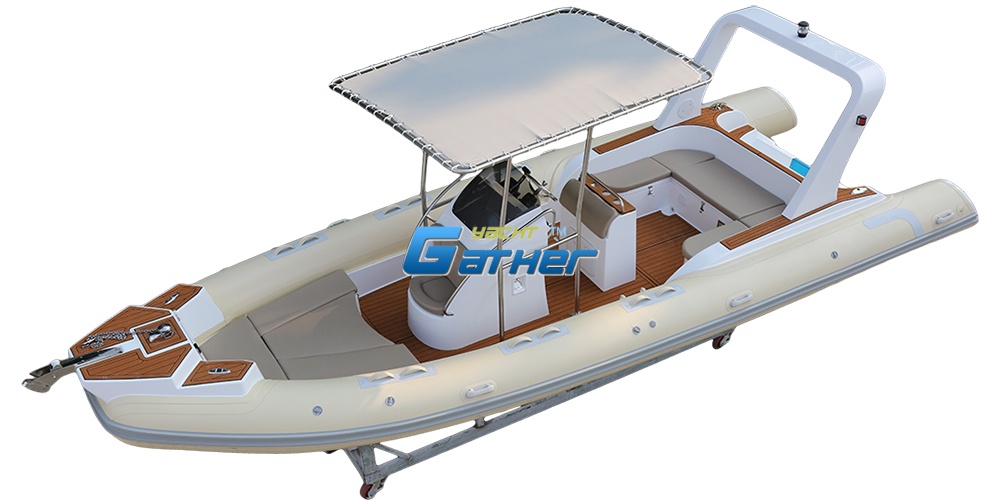
These vessels dominate demanding marine environments globally. They merge traditional fiberglass hulls with inflatable collars. They excel at high-speed transit. You rely on them heavily for towing water sports. They navigate choppy coastal waters with absolute authority.
Specific features closely tie to operational outcomes. The V-hull design transforms performance entirely. A deep fiberglass or aluminum V-hull cuts through waves directly. It displaces water efficiently. It never bounces over the surface like a flat roll-up. This delivers a remarkably drier ride. It guarantees a safer experience for all passengers. The inflatable tubes provide massive lateral stability concurrently.
Risk factor analysis matters significantly here. An Inflatable Boat of this caliber requires serious logistical commitments. A RIB cannot be folded or bagged. It requires a dedicated boat trailer. You must secure permanent storage space at a marina or driveway. You also need a highly capable towing vehicle.
Best Practice: Always verify the exact payload capacity plate before purchasing any hull type.
Common Mistake: Buying a heavy RIB without securing permanent trailer storage first.
Hull Type Capability Matrix
| Evaluation Feature | Soft-Bottom Roll-Up | Rigid Inflatable Boat (RIB) |
|---|---|---|
| Storage Profile | Highly compact, fits in storage bags | Requires dedicated trailer and permanent space |
| Wave Handling | Bounces over chop, wetter ride | Cuts through waves, drier and safer ride |
| Assembly Speed | 15-30 minutes of manual inflation/assembly | Instant deployment from a boat ramp |
| Weight Class | Lightweight, easy to carry manually | Heavy, requires towing vehicle |
You must evaluate categories based strictly on your specific summer use case. Each scenario demands distinct specifications. A generalist approach often leads to poor performance.
Cruisers need reliable ship-to-shore transportation constantly. You must evaluate the weight-to-capacity ratio ruthlessly. Ease of deployment from a mothership davit system is paramount. You also need excellent rowability. Engines sometimes fail unexpectedly. You must physically row the tender safely to shore.
Ideal specs usually target a length of 8 to 10 feet. Choose lightweight PVC for maximum portability. Consider a single-skin aluminum RIB for rocky shorelines. These configurations handle two adults and basic provisions perfectly.
Families demand functional internal volume for long days. You must evaluate usable deck space carefully. Payload capacity must accommodate multiple passengers and recreational gear safely. Outboard compatibility dictates performance here. You need enough power to push a heavily loaded hull onto a plane. Look for transoms supporting 15 to 25 HP outboards.
Ideal specs span the 11 to 14 feet range. A deep-V RIB provides exceptional passenger comfort. It cuts through afternoon chop gracefully. A heavy-duty aluminum floor roll-up serves as a practical alternative. It balances underway stability with off-season storage capabilities.
Fishermen subject inflatables to unique physical hazards. You must evaluate puncture resistance constantly. Errant hooks, sharp knives, and dorsal fins threaten the inflatable tubes. You require dedicated mounting points for rod holders. You also demand absolute deck stability for stand-up casting.
Ideal specs include thicker denier PVC fabrics. Look for heavily reinforced wear patches along the top tubes. Flat-profile floorboards work exceptionally well here. They provide the rock-solid, predictable platform anglers demand.
Sometimes standard recreational specifications fall dangerously short. You might need to upgrade to heavy-duty options. We must evaluate when these professional tiers become absolutely necessary.
Commercial operators push equipment to its absolute limits. Marine contractors and extreme offshore enthusiasts demand structural perfection. A standard recreational hull eventually shatters under these extreme workloads.
Core differentiators separate these vessels immediately. Professional hulls utilize multi-chambered oversized tubes. These provide massive buoyancy reserves. Builders integrate heavily reinforced transoms. These handle the immense torque of commercial outboards effortlessly. You will often find shock-mitigating jockey seating installed. The operator straddles the seat directly. The internal suspension absorbs violent wave impacts. It protects the spine during high-speed transits. You need a professional grade rigid inflatable boat for truly unforgiving environments.
Rescue crews operate when others seek immediate shelter. Operators frequently launch commercial rigid inflatable boat rescue missions in nightmare conditions. You must demand mission-critical features here. Self-bailing decks evacuate green water instantly. Heavy-duty rubbing strakes armor the tubes against jagged floating debris. Rapid-deployment capabilities allow instantaneous launching from larger Coast Guard cutters.
We must acknowledge the physical realities of these upgrades. Rescue-grade specifications add massive weight to the hull. The vessel behaves differently than a light recreational boat. It requires specialized operator training. You must understand heavy weather boat handling perfectly.
Offshore transit requires absolute mechanical redundancy. A single engine failure offshore creates a massive emergency. A twin engine rigid inflatable boat eliminates this specific danger entirely. It provides essential scalability and security.
You gain massive payload hauling capabilities immediately. You achieve superior maneuverability through split-engine controls. However, serious implementation constraints remain. You face an exponential increase in maintenance routines. You must manage highly complex rigging systems. You absolutely require heavy-duty towing vehicles for highway transport.
We must start with transparent, honest assumptions. No inflatable vessel lasts forever. UV degradation acts as the primary failure point across all categories. You must select your material based on local weather and daily storage habits.
This material dominates the recreational market globally.
Pros: It is highly accessible for most users. The fabric remains exceptionally lightweight. It provides excellent air retention over long periods. Manufacturers assemble PVC using advanced thermo-welding. This fuses the panels together permanently into a single structure.
Cons: PVC remains highly susceptible to UV and heat degradation. The chemical plasticizers evaporate over time. The material turns brittle after 5 to 7 years if left completely uncovered outdoors.
Verdict: PVC represents the logical choice for casual summer users. It performs brilliantly if you store the boat indoors. Using a high-quality UV cover extends its lifespan significantly.
Professionals universally prefer this rugged synthetic rubber.
Pros: It offers extreme resistance to UV rays. It ignores chemical spills and massive temperature fluctuations. A well-maintained Hypalon tube set easily lasts 15 to 20 years.
Cons: It demands heavier physical materials. The manufacturing process remains highly complex. You cannot thermo-weld Hypalon chemically. Workers must manually glue every single seam. This makes field repairs slightly more complicated.
Verdict: It remains mandatory for professional commercial operators. You strictly need it for tropical climates. It stands as the only logical choice for boats permanently moored outdoors.
Best Practice: Apply specialized UV-protectant sprays to PVC tubes monthly during active summer use.
Common Mistake: Using harsh petroleum-based cleaners on Hypalon, which severely degrades the fabric surface.
You now understand the critical technical differences. You are ready to explore the market for inflatable boats for sale. Follow a structured approach to narrow down your final options safely.
Determine the maximum storage footprint exactly. You must measure your garage or deck space. This dictates whether you choose a Roll-up or a RIB.
Calculate your intended passenger and gear payload precisely. You must account for heavy coolers and tackle. This dictates your required hull length and tube diameter.
Assess the primary operating environment honestly. You must evaluate your local UV index. This dictates your final choice between PVC and Hypalon.
You will choose between direct-to-consumer brands and local dealerships. Direct brands ship directly to your door. They shift the heavy burden of outboard rigging onto you. You must handle complex steering installations yourself. You also manage warranty claims remotely. Local dealerships provide turnkey, water-ready solutions.
Warranty scrutiny protects your investment long-term. Look strictly for transparent, prorated warranties. You should demand a minimum of 5 years of coverage on seams and materials. Read the exact clauses regarding environmental degradation.
Request sea trials wherever physically possible. You must feel how the boat handles wind and chop. If physical trials remain impossible, consult verified owner forums. Real-world feedback regarding specific models provides incredible clarity before you finalize the purchase.
The concept of a "best" boat is entirely relative. It depends strictly on your logistical constraints and local water conditions. You must define your reality first. A perfect boat for a calm lake angler fails a coastal rescue team.
Our baseline recommendation remains straightforward. Buy a high-quality PVC roll-up for casual weekend adventures. Invest in a heavy-duty Hypalon RIB for intensive, long-term maritime use.
Do not treat the boat as an isolated item. We strongly encourage buyers to finalize their engine sizing concurrently. You must also solve your storage plans before taking delivery. This holistic planning approach guarantees a smooth, highly enjoyable summer on the water.
A: Lifespan depends entirely on material choice and UV exposure. PVC models typically last 5 to 10 years. They degrade faster if left uncovered in direct sunlight. Hypalon (CSM) vessels offer superior UV resistance. They easily last 15 to 20 years or more with basic maintenance. Indoor storage dramatically extends the operational life of any inflatable vessel.
A: Registration laws vary heavily by local jurisdiction. Generally, manually propelled inflatables do not require registration. However, adding any motor changes this classification immediately. Even attaching a small electric trolling motor typically requires state registration and visible hull numbers. Always verify your specific local maritime regulations before launching.
A: Total catastrophic failure remains highly improbable. These vessels feature multiple independent air chambers. If a puncture deflates one chamber, the remaining chambers maintain enough buoyancy to keep the vessel afloat safely. Additionally, the inherent buoyancy of the tube fabric and rigid hull materials prevents the boat from sinking entirely.
A: You must consult the maximum horsepower rating on the vessel's transom plate. Never exceed this legal limit. Roll-up tenders typically require 2 to 10 HP. Mid-sized family cruisers perform best with 15 to 25 HP outboards. Large rigid hulls easily support 50 HP up to dual 300 HP commercial configurations.


