
- All
- Product Name
- Product Keyword
- Product Model
- Product Summary
- Product Description
- Multi Field Search
Views: 0 Author: Site Editor Publish Time: 2026-06-02 Origin: Site


Nothing ruins a perfect day on the water faster than an improperly sized engine. Selecting the ideal propulsion system for your watercraft requires careful calculations. You must balance required thrust against strict transom weight limitations. Overpowering your vessel risks structural failure and creates severe safety hazards. Conversely, underpowering leads to incredibly poor handling. You might even find yourself unable to plane against strong currents. We want you to avoid these stressful and dangerous situations.
Every single Inflatable Boat behaves differently depending on its power source. This guide provides a definitive framework for evaluating motor types safely. We will help you size horsepower accurately and match shaft lengths perfectly. You will learn how to navigate compliance requirements without second-guessing your choices. By following these core principles, you can finalize your propulsion setup confidently. We will explore everything from rigid designs to soft-deck models, ensuring you make an informed decision.
Transom ratings dictate limits: Never exceed the manufacturer’s max horsepower and weight specifications printed on the capacity plate.
Hull type drives power needs: A fiberglass hull rigid inflatable boat (RIB) requires significantly different power-to-weight ratios than a roll-up soft-bottom dinghy.
Gas vs. Electric is a use-case decision: Choose electric for quiet, localized use on restricted waters; choose gas for range, planing capabilities, and heavy payloads.
Shaft length is non-negotiable: Mismatching transom height and shaft length causes severe cavitation, drag, and engine damage.
Every vessel has absolute physical limits. Understanding these boundaries ensures safe operation on the water. Manufacturers design transoms to handle specific stress loads. Pushing past these boundaries invites catastrophic structural failure.
You will usually find the capacity plate mounted directly near the stern. It serves as a hard ceiling on maximum engine weight and horsepower. Regulatory bodies like the Coast Guard mandate these plates for consumer safety. Ignoring these stamped numbers violates federal regulations in many jurisdictions. It also places your passengers in immediate physical danger. Heavy motors change the center of gravity drastically. They pull the stern downward, increasing the risk of swamping over the back.
Hull rigidity dictates how efficiently a boat moves through water. Soft or air-deck hulls offer exceptional portability. However, they possess lower structural rigidity overall. They typically max out at lower horsepower ranges, usually between 2.5 HP and 15 HP. These models remain highly sensitive to motor weight. Adding a bulky engine defeats the purpose of a portable roll-up dinghy.
Conversely, a fiberglass hull rigid inflatable boat handles heavier, higher-horsepower outboards easily. Its solid V-hull requires more thrust to overcome initial drag. Once it breaks the surface tension, it achieves a stable plane. These rigid designs withstand the aggressive torque generated by powerful engines.
| Hull Category | Typical HP Range | Rigidity Level | Primary Use Case |
|---|---|---|---|
| Soft/Air Deck | 2.5 HP - 15 HP | Low to Moderate | Ship-to-shore, calm lakes |
| Aluminum Floor | 10 HP - 25 HP | High | Diving, fishing, utility |
| Rigid Hull (RIB) | 20 HP - 300+ HP | Maximum | Open water, high speed, rescue |
Exceeding transom weight limits carries severe consequences. A heavy engine applies extreme leverage against the mounting board. Hitting a single strong wave can cause transom tear-out. This rips the entire back off your vessel. Beyond immediate physical danger, overpowering voids your manufacturer warranty. It also exposes you to severe liability issues if an accident occurs.
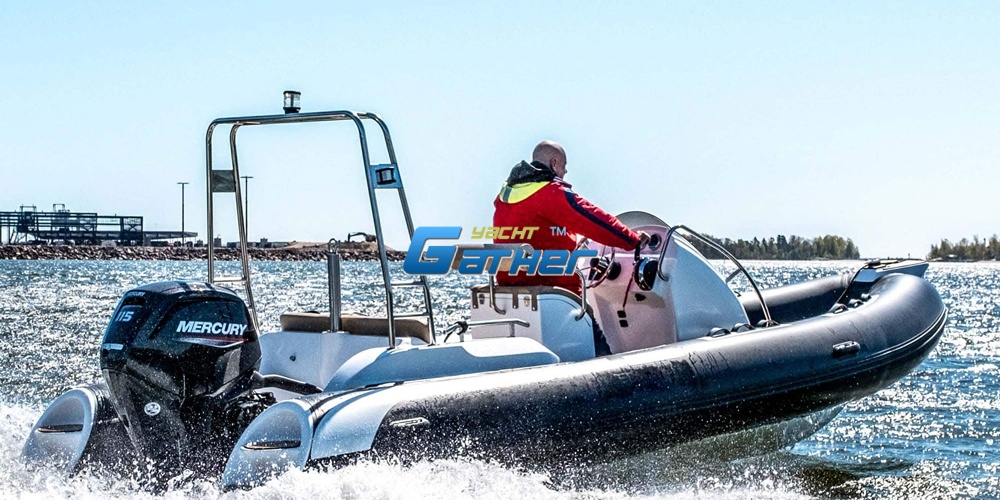
Selecting between electric and gas power depends entirely on your specific usage. Neither technology is universally superior. They serve completely different operational environments.
Electric motors excel as secondary trolling motors or primary power for small tenders. They fit perfectly on restricted lakes banning internal combustion engines. They perform exceptionally well during short-range harbor hops.
When measuring electric performance, you must compare thrust pounds against horsepower equivalents. A 55 lb thrust motor roughly matches a 2 HP gas engine. You must also calculate battery weight and discharge rates carefully. Heavy lead-acid batteries add excessive weight to small vessels. Modern lithium options solve this but require careful storage.
Electric propulsion carries strict limitations. You will experience significantly slower top speeds. Range anxiety remains a very real concern during longer trips. Upfront battery investments can be substantial.
Gas engines dominate open water environments. They handle heavy payloads easily. If you want to achieve actual planing speeds, gas remains your best option. You generally choose between 2-stroke and 4-stroke models.
Four-stroke engines represent the modern standard for emissions compliance. They deliver incredibly reliable torque across the RPM range. However, they are significantly heavier than older models. Manually lifting a modern 4-stroke onto a transom strains your back considerably.
Gas systems demand strict maintenance routines. You must stabilize fuel during storage. Carburetor care remains crucial for reliable starting. Winterization procedures protect internal components from freezing temperatures.
Determining the correct horsepower requires framing your desired outcome. You must decide if you simply want to move or if you need to fly across the water.
Boats operate in two distinct modes. Displacement speed means the hull pushes through the water. Planing speed means the hull lifts completely over the bow wave. It skims across the surface, reducing drag massively.
Displacement speeds require very little power. A simple 2 to 5 HP motor provides sufficient thrust for basic transport. It works perfectly for brief ship-to-shore trips. You will travel at around 5 miles per hour comfortably.
Achieving planing speeds requires substantial energy. You generally need 8 to 20+ HP depending on hull size. We recommend the standard industry rule of thumb: allocate 1 HP per 40-50 lbs of total weight. This total includes the boat, motor, fuel, gear, and all passengers.
Boat Weight: 120 lbs
Motor Weight: 90 lbs
Two Passengers: 360 lbs
Gear and Fuel: 50 lbs
Total Weight: 620 lbs
Required Power: 620 divided by 40 equals 15.5 HP. You should select a 15 HP motor.
Passenger count alters your effective horsepower requirements drastically. A 10 HP motor might plane easily with one person aboard. Adding a second passenger anchors the hull deep into the water. Heavy coolers, anchor chains, and full fuel tanks compound this issue. Always calculate your engine size based on your maximum expected payload, not an empty deck.
Buying the absolute maximum rated horsepower isn't always optimal. Max-rated engines add unnecessary weight to your stern. This extra mass increases your rear draft, making shallow-water navigation difficult. It also makes manual handling miserable. Wrestling a maximum-capacity engine onto a swaying dinghy often leads to dropped motors and personal injury.
Engine power means nothing if the propeller sits incorrectly in the water. Shaft length dictates operational success. Mismatched components destroy performance instantly.
You must measure your transom precisely before shopping. Follow these specific steps to guarantee accuracy:
Place your fully inflated vessel on flat, level ground.
Locate the absolute lowest point of the hull at the rear center.
Run a tape measure straight up the exterior face.
Stop at the top center edge of the mounting board.
This measurement dictates your exact shaft requirement.
Marine engines come in standardized lengths. A short shaft measures approximately 15 inches. It serves as the standard for most roll-up and smaller soft-bottom inflatables. A long shaft measures 20 inches. You typically see these on rigid hull models and larger professional inflatables. Extra-long shafts exist but rarely apply to recreational inflatables.
Failing to match dimensions guarantees mechanical problems. We see these errors frequently.
Too Short: The propeller sits too high. It sucks air from the surface, causing severe cavitation. The engine revs wildly but produces zero thrust. Worse, the water pump intake may rise above the waterline. This causes immediate, catastrophic overheating.
Too Long: The lower unit plunges deep underwater. This creates excessive drag. It ruins your top speed and burns excess fuel. A long shaft also dramatically increases your risk of striking underwater rocks or debris.
Implementation reality bites hard on the water. Physically lifting a 90lb outboard over the side of a larger yacht tests your balance. Swinging it onto a swaying dinghy transom challenges even strong individuals. Think carefully about weight distribution. If you boat alone, cap your motor weight at what you can comfortably lift chest-high while standing on an unstable surface.
Finalizing your choice involves looking beyond the spec sheet. You must evaluate the purchasing ecosystem. Support matters just as much as horsepower.
You can buy components separately or explore complete packages. Pre-configured inflatable boats with motor bundles often provide excellent cost efficiency. Manufacturers balance these packages precisely. They match the shaft length and maximum capacity for you. This eliminates guesswork completely. Buying separately allows hyper-customization but requires rigorous cross-checking on your part.
Never ignore local servicing availability. A cheaper direct-to-consumer engine looks great on paper. It loses all value if no local marine mechanic agrees to service it. Established brands carry robust dealer networks. When a carburetor clogs mid-season, local warranty support gets you back on the water quickly. Obscure brands often leave you stranded waiting months for imported parts.
Before executing any purchase, run through this final safety check:
Confirm the total motor weight stays strictly at or below the transom limit.
Confirm your chosen horsepower stays strictly at or below the capacity plate limit.
Confirm your required shaft length matches your exact transom height measurement.
Finalize your logistical layout for fuel tank placement or heavy battery storage.
Selecting the right propulsion system guarantees safety and enjoyment on the water. The ideal motor aligns perfectly with your hull's structural limits without pushing stress boundaries. It matches your specific use case, whether you prioritize silent portability or heavy-duty planing power. Above all, it fits your exact transom dimensions to ensure flawless hydrodynamic performance.
We encourage you to inspect your capacity plates immediately. Calculate your average payload using the formula provided earlier. Once you establish your hard limits, you can confidently browse current inventories of inflatable boats for sale or secure the perfect standalone outboard for your next adventure.
A: No. You can only mount a motor on boats featuring a rigid, reinforced transom specifically designed for propulsion. Mounting an engine on a non-rated recreational raft represents a severe safety hazard and guarantees hull tearing.
A: It varies heavily by local jurisdiction and motor size. Many regions require a boater safety card for anything exceeding 9.9 HP. Others require official registration for any motorized vessel, including small electric trolling motors. Always verify local laws before launching.
A: It creates excessive underwater drag, significantly reducing your top speed and negatively impacting fuel efficiency. It also alters the boat's center of gravity dangerously, making the stern sit lower and increasing your risk of swamping.
A: A modern 9.9 HP 4-stroke usually weighs between 85 and 100 lbs. Lifting this weight over the water often requires two adults or a mechanical hoist to mount safely without risking injury or dropping the unit.


